

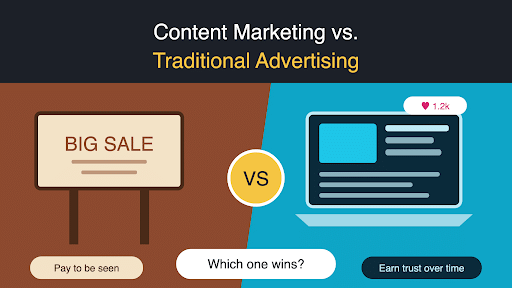
Businesses have more ways to reach customers today than ever before. A company can publish useful articles, create videos, run social media campaigns, send emails, place search ads, or invest in traditional channels such as television, radio, newspapers, and billboards.
With so many choices available, one question comes up frequently: should a business invest in content marketing or traditional advertising?
The answer depends on the company’s goals, audience, budget, and timeline. Neither approach is automatically right for every business. Understanding how each works can help companies decide where their marketing resources are likely to be most useful.
What Is Content Marketing?
Content marketing focuses on creating useful information for a particular audience.
Instead of directly asking someone to buy something, a business might publish a guide, answer a common question, create a video, or share information that helps customers solve a problem.
For example, a roofing company could publish an article explaining how homeowners can tell whether their roof needs repair or replacement. A dentist might create a guide explaining what patients should expect during a particular procedure.
The idea is simple: provide something useful before asking for the sale.
Over time, this content can attract people through search engines, social media, email, and other channels.
What Is Traditional Advertising?
Traditional advertising involves paying for exposure through established media channels.
Common examples include:
- Television commercials
- Radio advertisements
- Newspaper ads
- Magazine placements
- Billboards
- Direct mail
- Printed flyers
- Outdoor signage
The model is straightforward. A business pays for a specific placement and uses that space to communicate its message to an audience.
Traditional advertising can still be useful for companies that want broad local exposure or need to promote something within a specific timeframe.
The main difference is that the exposure generally depends on continued advertising spend.
Content Can Continue Working After Publication
One of the biggest differences between content marketing and traditional advertising is what happens after the initial investment.
A traditional advertisement usually has a defined lifespan. Once the campaign ends, the exposure largely stops.
A useful online article, however, can continue attracting visitors long after it has been published.
For example, an article answering a common customer question may rank in search results and bring visitors to a website months or even years later.
That doesn’t mean every piece of content will continue generating traffic indefinitely. Search results change, competitors publish new material, and information becomes outdated. Still, well-maintained content can become a long-term digital asset.
Traditional Advertising Offers Immediate Exposure
Traditional advertising has a different advantage: speed.
A company can purchase a billboard, newspaper placement, radio spot, or television commercial and begin reaching an audience relatively quickly.
This can be helpful when promoting a limited-time offer, opening a new location, launching a product, or creating awareness around an event.
Content marketing usually takes longer. A new article may need time to be indexed, gain visibility, and attract meaningful traffic.
Businesses therefore need to consider whether they need immediate exposure or are prepared to invest in longer-term visibility.
Targeting Works Differently
Traditional advertising often focuses on reaching a broad audience. A radio station, newspaper, or billboard may expose an advertisement to thousands of people, but many of those people may have no immediate need for the product or service.
Content marketing can take a more specific approach.
A business can create content around particular services, customer questions, industries, locations, and problems. Search behavior can then bring that content in front of people who are actively looking for related information.
That difference can be especially valuable for service businesses and companies operating in specialized markets.
Content Can Help Build Authority
People don’t always want to be sold to.
Before contacting a company, potential customers often research their options. They may compare providers, read reviews, investigate pricing, or search for answers about the service they need.
Useful content gives a business an opportunity to demonstrate its knowledge during this research process.
A company that consistently publishes accurate and practical information can become a useful resource within its industry. Over time, that can help create familiarity and trust.
This is especially relevant for professional services, where customers often want to understand a company before deciding whether to make contact.
Advertising Can Build Brand Recognition
Traditional advertising should not be dismissed simply because digital marketing has become more prominent.
Repeated exposure can help people remember a company. A local business that appears regularly on billboards, radio, or other media may become familiar to people in its service area.
Advertising can also work alongside digital marketing. Someone may see an advertisement and later search for the company online. When they arrive at a website, having modern digital experiences can make that transition much smoother and give visitors a consistent way to learn about the company, its services, and its value.
This is where offline and online marketing can complement one another.
Measuring Results Is Different
Another major difference is measurement.
Traditional advertising can be difficult to track precisely. Businesses may be able to estimate how many people were exposed to a campaign, but determining exactly how many customers came from a particular billboard or radio advertisement can be challenging.
Digital content provides more measurable information.
Businesses can monitor website visits, search impressions, keyword rankings, page engagement, form submissions, phone calls, and other actions.
These metrics don’t explain everything, but they can help businesses understand which topics attract attention and which pages contribute to conversions.
The Two Strategies Can Work Together
Businesses don’t necessarily have to choose one approach.
Traditional advertising can generate awareness while content marketing helps capture people who research the company afterward.
For example, a local business could run a radio campaign promoting a particular service while publishing detailed website content answering common questions about that service. Someone who hears the advertisement and later searches for the company can then find useful information online.
The same principle can apply to print advertising, direct mail, sponsorships, and outdoor campaigns.
Which Approach Should a Business Use?
The right combination depends on the business.
A company launching a new product may benefit from advertising because it can generate awareness quickly. A service business trying to attract customers through Google searches may place more emphasis on content, SEO, and its website.
Budget is another consideration. Traditional advertising can require significant ongoing spending, while content marketing requires investment in research, writing, design, optimization, and promotion.
Businesses should therefore look beyond the initial cost and consider how long they expect the marketing activity to produce value.
Content Marketing Needs a Strategy
Publishing random blog posts is unlikely to produce meaningful results on its own.
Effective content marketing starts with understanding the target audience and identifying the questions, problems, and services that matter to potential customers.
Content should then connect naturally with the rest of the website. Relevant articles can link to service pages, product pages, case studies, and contact pages, giving readers a clear path when they are ready to take the next step.
Search optimization can also help useful content reach people who are already looking for related information.
Businesses that want to connect content with a broader search strategy can turn to Portkey SEO Solutions for support with organic visibility and search-focused marketing.
Thoughts
Content marketing and traditional advertising serve different purposes.
Traditional advertising can provide fast exposure and help build brand recognition, while content marketing can create useful resources that continue attracting and educating potential customers over time.
For many businesses, the most practical approach is not to treat them as competing strategies. Advertising can introduce people to a company, while useful content and a strong website can help turn that awareness into research, trust, and eventually a customer relationship.
The most effective marketing mix will depend on the audience, business goals, available resources, and expected timeframe. Rather than choosing a strategy simply because it is popular, businesses should consider how each channel fits into the way their customers actually discover, research, and choose a company.